
“Hands up if you can name this little-known member of the world economy:
- Every year, it provides services valued at between USD $120-$140 trillion—more than 1.5 times the entire annual global GDP.
- More than 55% of the world’s GDP depends on its services.
- It is by far the cheapest and most effective source of the services it offers—and it is in danger of going out of business.
This vital component of the economy is biodiversity. But ecosystem are collapsing as species go extinct—and the cost to business is massive.”
5 Main Threats to Biodiversity | Network for Business Sustainability
Roles: Writer (uncredited by agreement), researcher
NBS is an exciting organization with a tough brief: to take often-turgid academic reports on sustainability and turn them into web articles aimed at business leaders who aren’t necessarily sold on the need to act for the environment. It calls for a writer who can grasp the technicalities of scientific studies and “translate” them accurately into engaging copy at the layperson’s level, with a clear “what’s in it for me” element.
This was one of my all-time favourite gigs. It tapped into my academic chops, my Strunk-and-Whiteian obsession with clean, active prose, and my love of persuasive writing. I joined another PhD, who heads up NBS, in tackling the rewrites, and occasionally, as with this piece, contributed original articles to series whose lead author was another content writer.
The Lab | Innovation North
Roles: Primary content writer and co-conceiver for first iteration
For Dr. Tima Bansal, the founder and head of Innovation North, the problem was a thorny one: scholars, researchers, and thought leaders around the world were devising ways for businesses to operate in more sustainable ways, but the business world had no point of connection with these people or their ideas. Being a woman of action, Dr. Bansal created Innovation North, whose “lab” originally comprised quarterly meetings of Canadian business heavyweights, such as the heads of Walmart Canada and McDonald’s Canada, to brainstorm sustainability innovations on a systemic level.
By the time the website was conceived, the mandate for “Inno North” had broadened to include building networks of innovation leaders and a community where business leaders could interact directly with sustainability-systems researchers and scholars. I was brought in to help put clear, active language to this passel of abstract concepts. My work survives in a few spots.

“We know that organizations that do not innovate will fail. What may have helped them succeed in the past could cause them to fail in the future. In a dynamic landscape, organizations need to innovate to survive in the longer term. They need to continually adapt and evolve to meet the changing needs of their environment.
Macro-disruptions, whether they’re pandemics, technologies, or climate change, require businesses to innovate not just new products, services or processes, but systems. Many businesses want to meet current challenges but don’t know how or where to begin.”

“Neoline is a French start-up with an ambitious solution. The company has designed a sailing cargo ship powered almost entirely by wind. Using the inexhaustible power of marine wind in its 14,000 square feet of sail, the Neoliner has the potential to reduce greenhouse-gas emissions on ocean crossings by 90%.”
The Future of Shipping – Wind Power | Forbes.com
By Tima Bansal
Roles: Substantive editor / re-writer, researcher, copy editor, display-copy writer, proofreader
For a backyard eco-scientist like me, working with Dr. Tima Bansal, Canadian Chair of Sustainability in Business at the Ivey School of Business (Western University), was a fantastic opportunity. Dr. Bansal not only had founded the Network for Business Sustainability (see previous sample) and Innovation North (see Content Writing page), but had just started writing for Forbes.com on sustainability issues.
I worked with Dr. Bansal on all three of these initiatives, happy to exploit the intersection of my 10 years as a writing coach for MBA students, my doctoral dissertation areas of biophilia and evolutionary psychology, and my passion for writing about the environment. Most of Dr. Bansal’s pieces for Forbes.com needed only a light touch; occasionally, as with this article, they required more of a substantive edit, including additional research.
“‘I shall live for ever and ever!’: Ecological Perspectives on Immortality in Children’s Fantasy | PhD Dissertation, University of Connecticut, 2015
Children’s literature has traditionally been analyzed through humanist critical frameworks such as psychoanalysis and gender theory. These approaches, while effective in some respects, do little to accommodate or account for the superabundance of animals, rural settings, and reverent representations of the natural matrix in children’s literature.
This project examines the genre instead from an “inhumanist” biological and sociobiological viewpoint. It posits that children’s literature has for the past 100-plus years acted to foster and transmit what E. O. Wilson calls “biophilia”: an evolution-based affinity for other living things, expressed through a pervasive set of impulses and predispositions. Focusing on a number of children’s fantasies from the early 1900s to the start of the new millennium, the project shows how a syncretic biotheism has arisen in and become endemic to children’s literature, and how, concomitantly, the genre firmly rejects immortalist thinking—whether the Western/Christian conception of “post-death” immortality or the techno-secular pursuit of “pre-death” life extension.
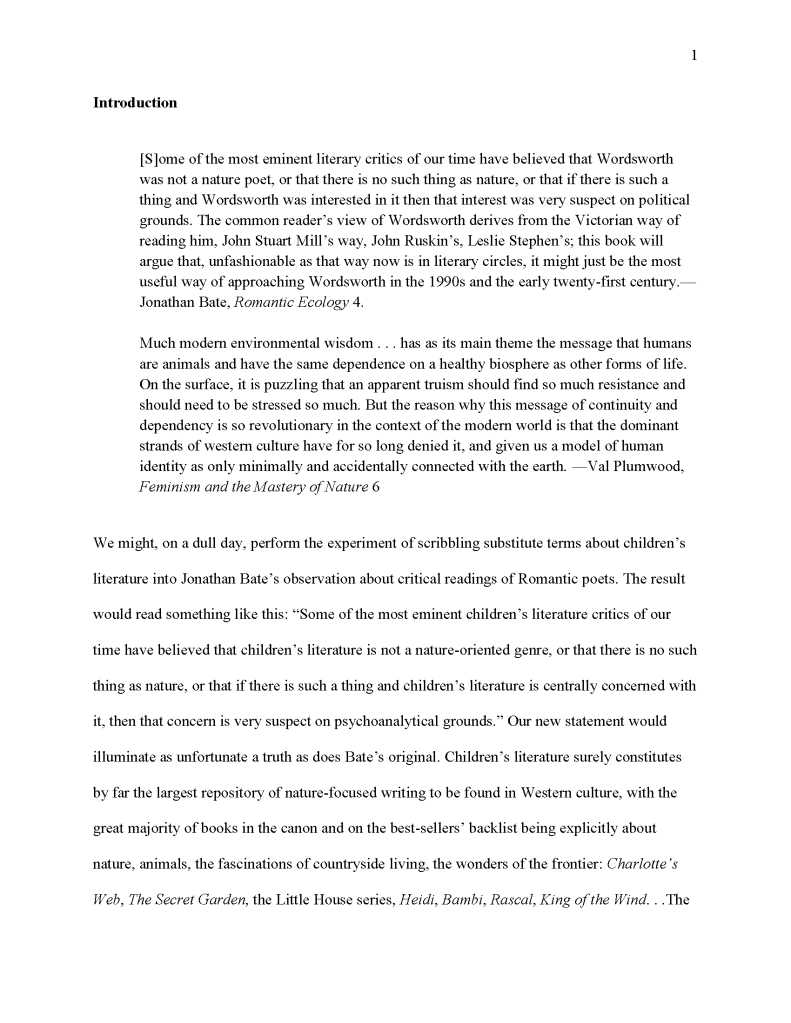
“What is the view of the “common” child reader, free of the hermeneutics of suspicion or, most likely, hermeneutics of any kind? What cumulative worldview does she or he get from reading after book about dogs and cats, farm life, the open prairie; about climbing trees and swimming in brooks; about tending orphaned wildlife and yearning more than anything for a horse? And, as a related question, how does this ingestion of nature-rich books affect what Sidney I. Dobrin terms “ecological literacy” (Wild Things 233)––that is, what children’s texts individually and collectively “teach” the child reader about the natural world, whether by omission or commission?”
 Pamela Swanigan portfolio