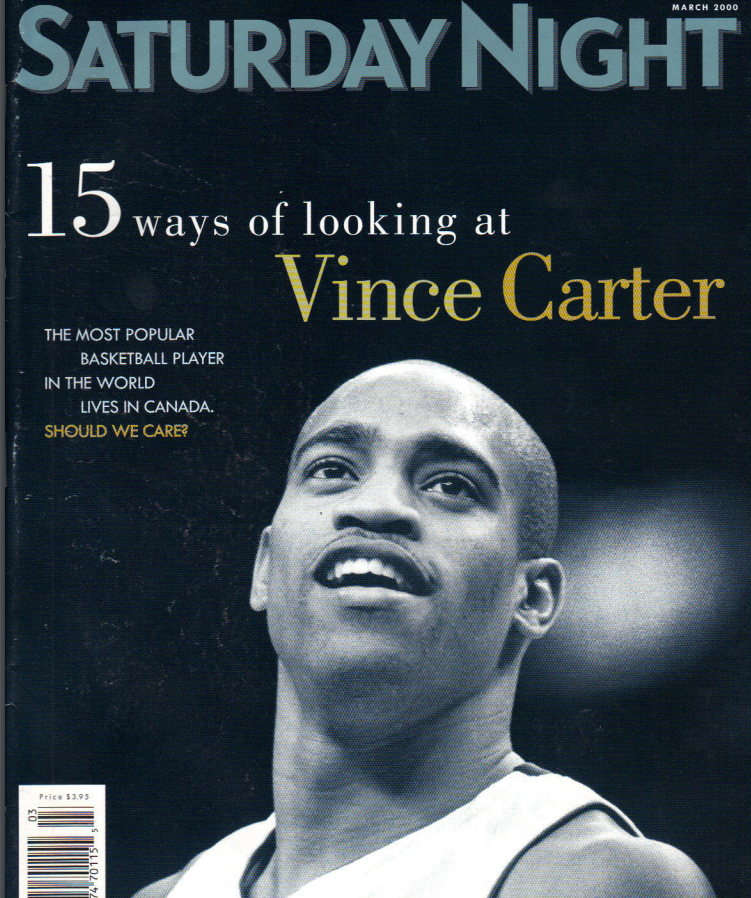
“We try not to think about Vince Carter much in Vancouver. He reminds of us Toronto, and, even worse, he reminds us of the NBA. A hundred years of serving as central Canada’s favourite banana republic, and thirty of watching our hockey team play rubes to the Maple Leafs, has nothing on this quotidian torture we call Vancouver Grizzlies Fandom, this interminable march of losing box scores across our retinas, all the while with the echo in our ears of the Raptors ha-ha-ing across the distance. It’s so relentless. It’s unfair. It’s so televised.”
15 ways of looking at Vince Carter | Saturday Night magazine
My way of looking at him: “As Torontonian.” (The Grizzlies were the worst-ever team; Carter was making the Raptors look good…)
Winner (shared) of the Silver Medal and Honourable Mention, National Magazine Awards 2001.
I Am Half-Canadian | Saturday Night magazine
Is the Great Canadian Identity Crisis really such a bad thing? I look to my very self-assured home country to give a second opinion.
Reprinted in Acting on Words: A Reader, Rhetoric, Grammar. Nelson Thompson, 2001 and 2008.
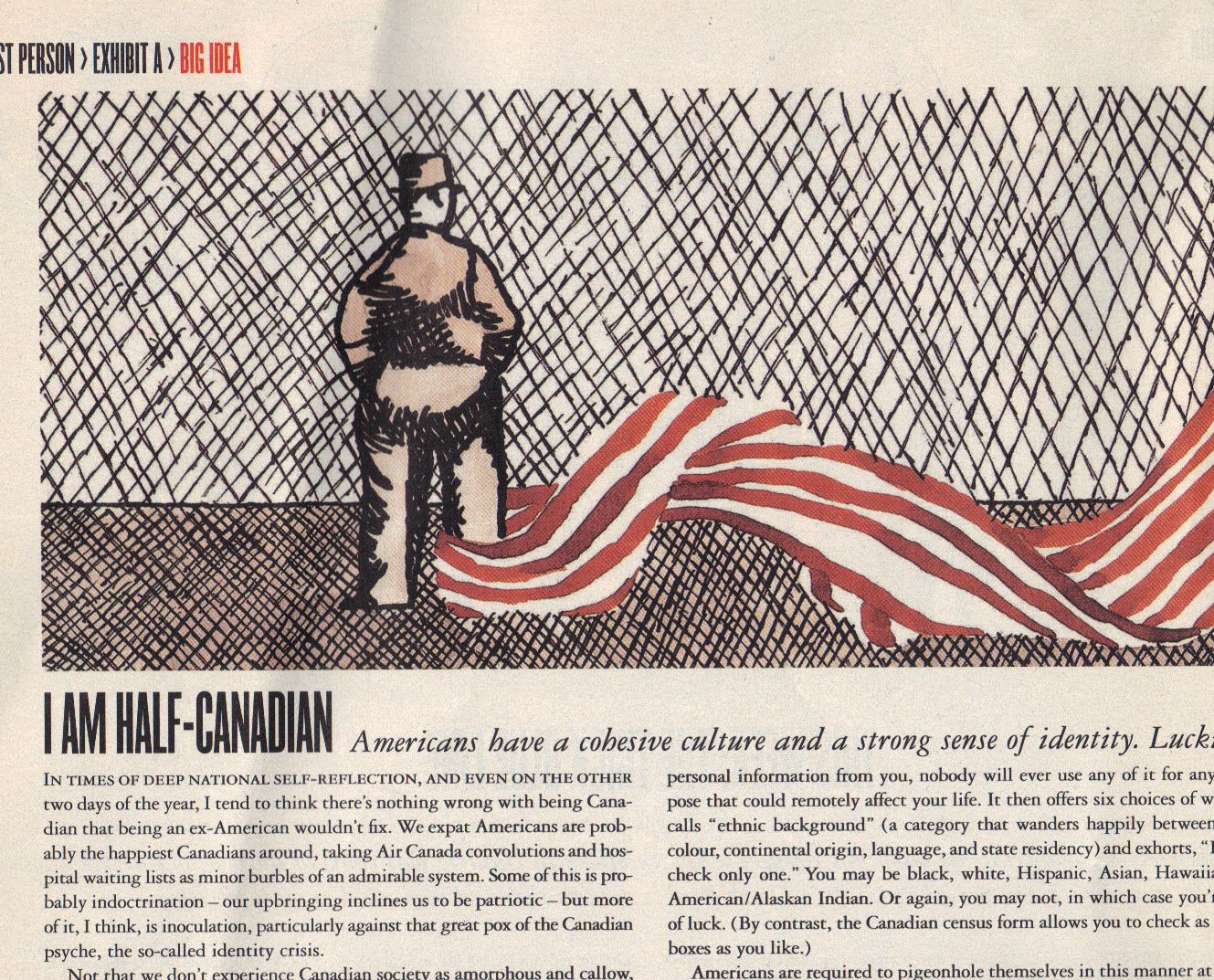
“Take, for instance, a typical American employment form, such as the one I recently received from a college in California. ‘Federal and state mandates require that we compile summary data on the gender and ethnicity of the applicants,’ it declares, before offering you six choices of what it calls ‘ethnic background’—a category that wanders happily between skin colour, continental origin, language, and state residency. You may be black, white, Hispanic, Asian Hawaiian, or American/Alaskan Indian. Or again, you may not, in which case you’re out of luck.”
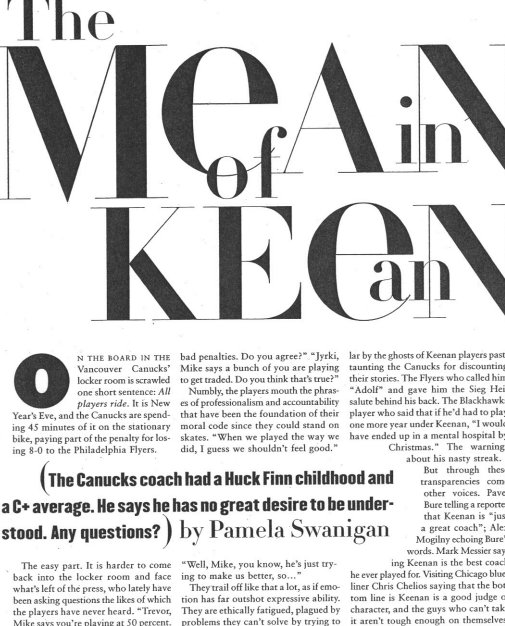
“With Keenan’s arrival, the conversation has turned contentious. A virtual Mason-Dixon line is drawn between those who thinks Keenan’s ends justify his means and those who think meanness cannot be justified by any end. The former call the latter sentimentalists. The latter accuse the former of heartlessness. Mike Keenan is exactly what’s wrong with pro sports, complain the sentimentalists. ‘Niceness’ is exactly what’s wrong with the Canucks, say the Keenanites.”
The Meanin’ of Keenan | Vancouver magazine
The day Iron Mike came to coach in Vancouver was a cold, dark day. “See if you can find someone with a positive take,” my editor told me. “Chris Chelios is said to be a fan.”
I went up to Chelios next game. “I hear you have some good things to say about Mike Keenan,”
said I.
“No,” said he…
The Book of Love | Vancouver magazine
In which I go to a Romance Writers of America conference and learn what to do about my saggy middles. (Referring to my Harlequin manuscripts, of course.)
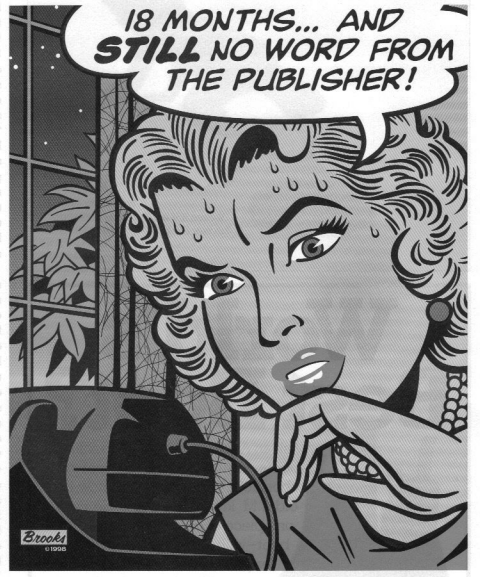
“It’s Saturday morning, and I’m sitting in the Crystal Room of Victoria’s Empress Hotel learning how to create conflict. Not everyone who knows me would agree that I need help in this area, but as I listen to speaker Naomi Horton, I realize that I’m truly an amateur. ‘Go deep!’ she exhorts. ‘Go for the real murky stuff: the wounds, the self-delusions, the deeper fermentations. Guilt is great. And if that doesn’t work, try dead babies.’
‘Try dead babies,’ we write dutifully in our notebooks.”
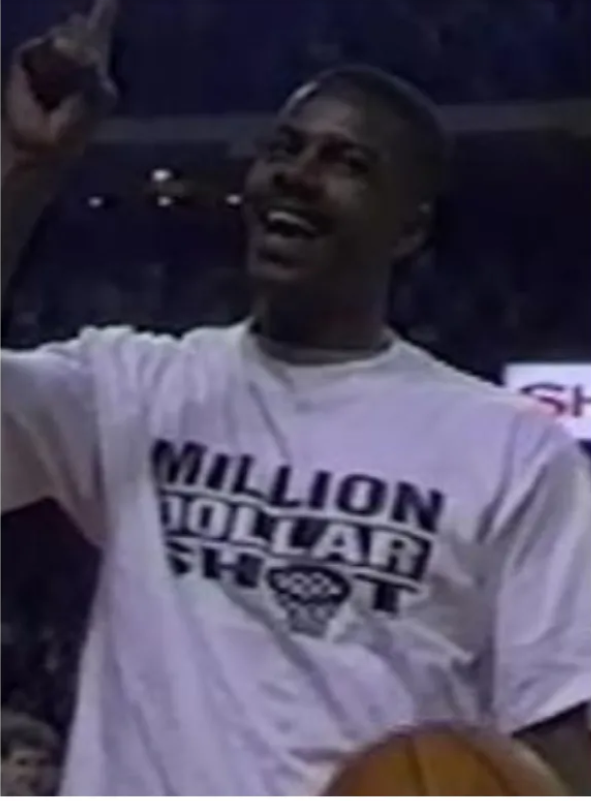
“It seems to me that in a country of million where only a few thousand people make their living as athletes, and where to be young and black and male is to be dead more likely than rich, Don Calhoun epitomized basketball and what it means to be an athlete.
His one shot captured the lottery essence of “if you practise hard enough…”. His instant rags-to-riches status mirrored not only the inequities but the skewed priorities of the economic system. And behind our exhilarated reaction was a collective need to believe that in happenstance lies a reality and a solution and a desire to glorify those who allow us to believe them.”
The Million Dollar Shot | The Toronto Star, reprinted in The Vancouver Sun
It was always strange covering the Bulls at Chicago Stadium: going in through the surrealistically named Gate 3 1/2 as if we were a member of the team, getting fed a seven-course pre-game meal in one of the poorest neighbourhoods in America. It was especially strange on the night of April 14, 1993. The team was at odds with the media because of questions about Michael Jordan’s gambling; they shut us out at practice. Forward Horace Grant wasn’t talking to me: he thought I’d made him sound racist in a story I’d sold to the Chicago Tribune about a conversation I’d had with MJ about my own racial identity.
And it was strange to be sitting three feet from the hoop when a young Black man named Don Calhoun threw the ball the length of the court to win $1 million. From where we were, we could see that it was going to go in. It did go in. Calhoun entered the stadium a sales clerk making minimum wage and left it as a millionaire. It seemed to me to sum up the strange fantasy that is the NBA and the lottery reality behind America’s rag-to-riches fantasy.
On the way home, on the Amtrak train to Toronto, I saw a wolverine outside the train window, loping across the snow under the moonlight. Only months later did I realize that at the time, we had been going through Michigan, where wolverines had been considered extinct since the mid-1800s.
 Pamela Swanigan portfolio